Deeply Learning 2: Cross Entropy Loss Implementation from scratch
Deeply learning one concept at a time. In this post, we implement cross entropy loss from scratch.
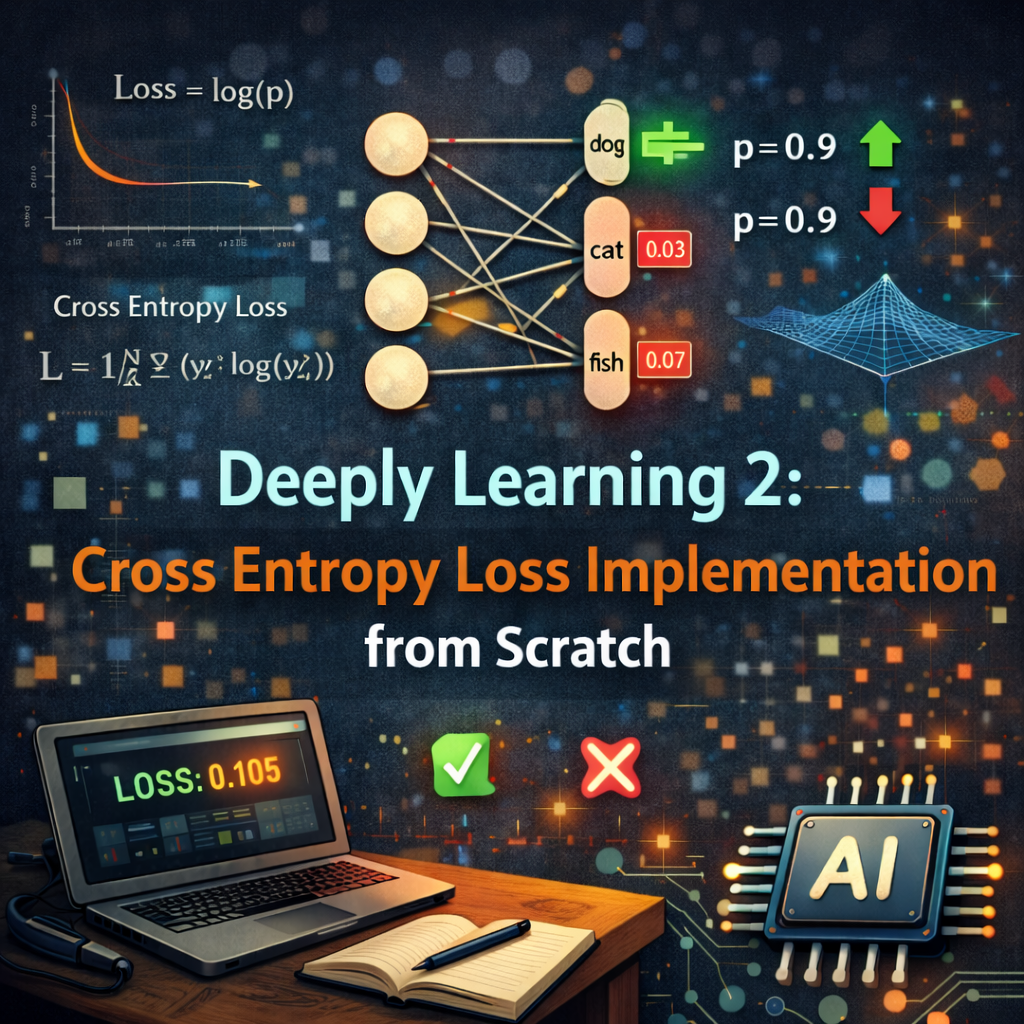
Deeply Learning 2: Cross Entropy Loss Implementation from scratch
Deeply learning one concept at a time. In this post, we implement cross entropy loss from scratch.
Introduction
Cross entropy loss is one of the most commonly used loss functions in classification problems. It measures the difference between two probability distributions: the true distribution (from the ground truth labels) and the predicted distribution (from the model’s output).
The Core Idea
The cross entropy loss for a single sample can be defined as: \(L = -\sum_{i=1}^{C} y_i \log(p_i)\) Where:
- $C$ is the number of classes.
- $y_i$ is the true label for class $i$ (1 if the sample belongs to class $i$, otherwise 0).
- $p_i$ is the predicted probability for class $i$.
Why log(p)? Idea is to capture how surprised we are when the model makes a wrong prediction. The logarithm here is used to penalize incorrect predictions more heavily. If the model predicts 99% probability for the correct class, resulting in low surprise, the loss will be low. However, if the model predicts a low probability for the correct class, the loss will be high, indicating a high level of surprise. This encourages that gradient flow will be stronger when the model is making incorrect predictions, which helps in faster learning. \(\frac{\partial L}{\partial p_i} = -\frac{y_i}{p_i}\) This gradient is used during backpropagation to update the model’s parameters.
Implementation from Scratch
Let’s implement the cross entropy loss from scratch using just basic Pytorch operations.
1
2
3
4
5
6
7
8
9
10
11
12
13
14
15
16
17
18
19
20
21
22
23
24
25
import torch
import torch.nn as nn
import torch.nn.functional as F
from jaxtyping import Float, Int
from torch import Tensor

class CrossEntropyLossFromScratch(nn.Module):
  def __init__(self):
    super().__init__()

  def forward(
    self,
    logits: Int[Tensor, "batch_size num_classes"],
    targets: Int[Tensor, "batch_size"]
    ) -> Float[Tensor, ""]:
    batch_size, num_classes = logits.shape
    assert targets.shape == (batch_size,)

    max_logits, _ = torch.max(logits, dim=1, keepdim=True) #[batch_size, 1]
    logits = logits - max_logits # stabize the logits #[batch_size, num_classes]
    sum_exp_logits = torch.sum(torch.exp(logits), dim=1, keepdim=True) #[batch_size, 1]
    log_probs = logits - torch.log(sum_exp_logits) #[batch_size, num_classes]
    loss = -log_probs[torch.arange(batch_size), targets] #[batch_size]
    return loss.mean()
1
2
3
4
5
6
7
8
9
10
11
12
13
# a random logit tensor and target tensor for testing
torch.manual_seed(0)
logits = torch.randn(4, 3) # [batch_size, num_classes]
targets = torch.tensor([0, 1, 2, 1]) # [batch_size]

criterion = CrossEntropyLossFromScratch()
loss = criterion(logits, targets)
print(f"Cross Entropy Loss: {loss.item():.4f}")

torch_loss = F.cross_entropy(logits, targets)
print(f"PyTorch Cross Entropy Loss: {torch_loss.item():.4f}")

print(f'Losses are close: {torch.isclose(loss, torch_loss)}')
1
2
3
Cross Entropy Loss: 1.4412
PyTorch Cross Entropy Loss: 1.4412
Losses are close: True
Key Takeaways
- Cross entropy loss captures the difference between true and predicted distributions.
- It penalizes incorrect predictions more heavily, encouraging the model to learn faster.
- The gradient of the loss with respect to the predicted probabilities is used for backpropagation